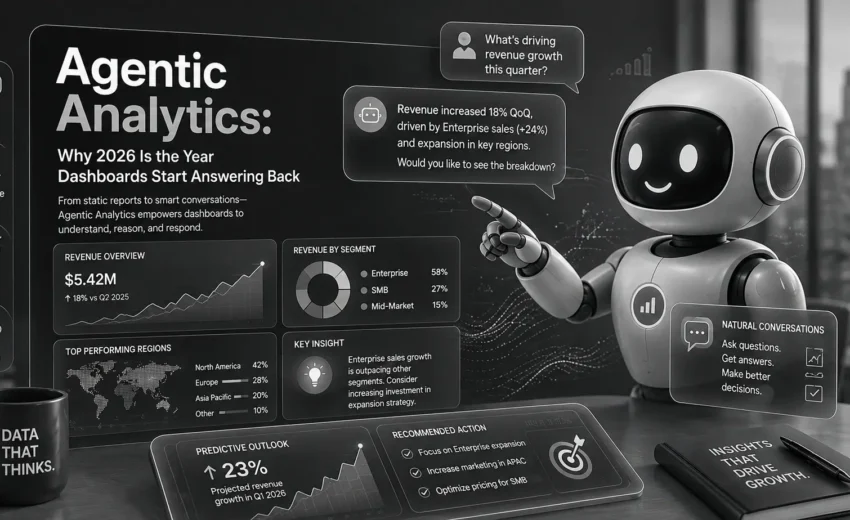
For years, “data-driven” meant building a dashboard, waiting for someone on the BI team to update it, and hoping the number you needed was on the screen. That model is quietly falling apart in 2026, and the reason is agentic analytics.
From Dashboards to Conversations
The old workflow looked like this: a manager has a question, opens a ticket, a data analyst writes a query, and days later a report lands in an inbox — often answering a slightly different question than the one that was actually asked.
Agentic analytics flips that sequence. Instead of clicking through filters, a business user simply types a question in plain language — “why did returns spike in the north region last month?” — and an AI agent does the rest: it identifies the relevant tables, runs the query, checks for anomalies, and returns a chart with a plain-English explanation attached. No SQL. No waiting on a queue.
What’s changed isn’t the idea — natural-language BI tools have existed for years — it’s the reliability. Large language models have crossed a threshold where they can be trusted to sit in front of production data, and enterprises have stopped treating this as a demo feature and started shipping it as a default expectation.
Why This Matters More Than It Sounds
The interesting shift isn’t the chatbot layer on top — it’s what it forces underneath. An AI agent can only answer a question correctly if the data feeding it is clean, current, and well-governed. Several recent industry surveys have found that a large majority of data leaders admit their existing data infrastructure isn’t ready for this — messy, duplicated, or stale data undermines even the most sophisticated agent.
That means the real 2026 story isn’t “AI replaces analysts.” It’s that the value of an analyst is moving up the stack — from writing queries to designing the data foundations, governance rules, and guardrails that make an AI agent trustworthy in the first place.
What This Means for Businesses (and Analysts)
If you’re a business leader, the takeaway is simple: before investing in an AI-powered analytics tool, invest in the data hygiene underneath it. A brilliant model on top of bad data still gives bad answers — just faster and with more confidence.
If you’re building a career in data — as an analyst, engineer, or Power BI developer — this is the moment to lean into the parts of the job that agents can’t automate yet: understanding business context, validating whether an “insight” actually makes sense, and designing the data models that agents query against.
The dashboards of 2026 don’t just display numbers anymore. They talk back. The organizations winning with this shift are the ones who made sure what’s talking back is actually telling the truth.
Interested in bringing agentic, AI-powered analytics into your own organization? Get in touch — I help teams build the data foundations and Power BI/AI systems this shift depends on.