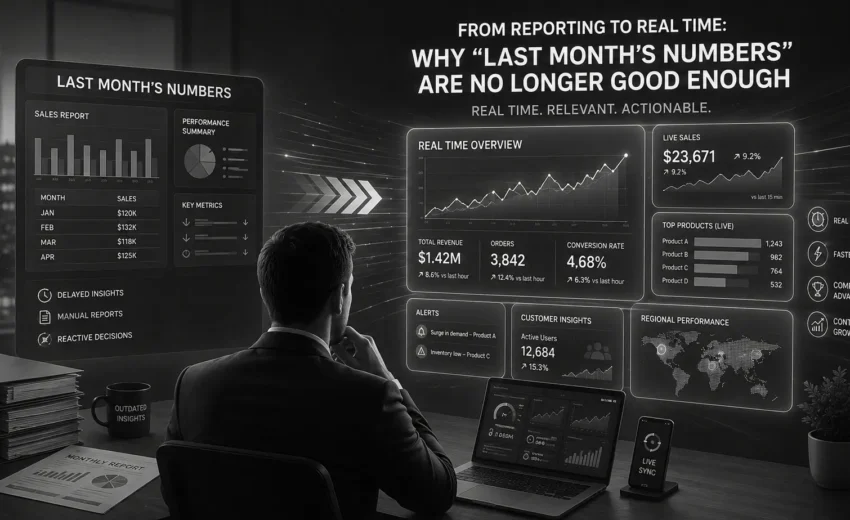
There was a time when exporting last month’s data into a spreadsheet and analyzing it a few weeks later counted as “doing analytics.” That era is ending fast, and the shift tells us a lot about where data careers and business decisions are heading in 2026.
The Shift From Looking Back to Looking Now
Traditional BI was built around a simple loop: collect data, batch-process it overnight, build a report, present it in next week’s meeting. It worked when business moved at the pace of a monthly review. It doesn’t work when a customer churns, a supply chain breaks, or a fraud pattern emerges in the middle of a business day.
Real-time and near-real-time analytics have moved from “nice to have” to default expectation across industries — retail, finance, logistics, and healthcare especially. Streaming data pipelines combined with cached, fast-access data layers now let organizations see what’s happening as it happens, instead of reconstructing it two weeks later.
Decision Intelligence: Closing the Loop
The more interesting evolution isn’t just speed — it’s what organizations do with that speed. The newer concept gaining traction is “decision intelligence”: analytics that doesn’t just describe what happened, but feeds directly back into the action that happens next, closing the loop between insight and decision.
Picture the difference:
Old model: A report shows warehouse stock is running low. A manager reads it Thursday and orders more Friday.
Decision intelligence model: The system detects the same pattern in real time, flags the reorder threshold, and either recommends or automatically triggers the restock — with a human able to review or override it.
This is a genuine shift in what “analytics” means as a discipline. It’s no longer just measurement — it’s becoming part of the operating system of the business.
What This Means Practically
For businesses, the message is that dashboards built around monthly or weekly refresh cycles are increasingly a liability, not a convenience. The competitive gap is widening between organizations that can see and respond to what’s happening today, and those still working from last month’s snapshot.
For people building data careers, this raises the bar on what skills matter. It’s no longer enough to know how to build a static report. The valuable skills now include:
Working with streaming and event-driven data pipelines
Understanding when real-time actually matters (and when it’s overkill and unnecessary cost)
Designing systems where analytics feeds directly into automated or semi-automated decisions, not just a dashboard
Real-time isn’t about vanity metrics refreshing faster. It’s about shrinking the distance between “something happened” and “we did something about it.” The organizations that close that gap fastest, safely and accurately, are the ones setting the pace in their industries this year — and the ones worth watching as the space keeps moving.
Curious what real-time, AI-augmented analytics could look like inside your own operations? I help organizations design data systems that don’t just report on the past — they keep up with the present.